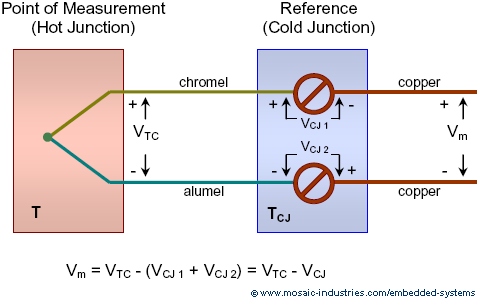
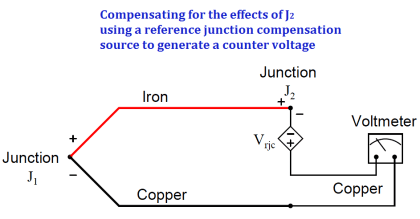
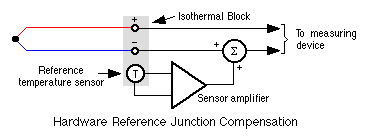
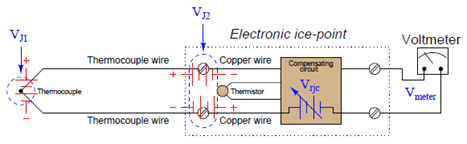
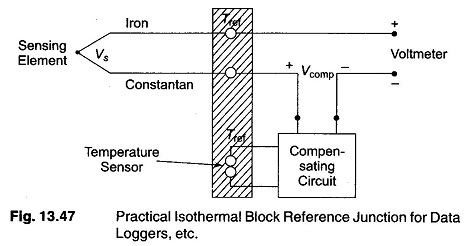
In order for such a compensation strategy to work, the compensating voltage must continuously track the voltage. Without proper compensation, the temperature reading will be offset by the temperature of the reference junction Cold junction compensation, or reference junction compensation, is the process of adjusting the calculation of a thermocouple’s voltage measurement to properly account for what the voltage would.
Thermocouple and RTDs- Introduction to Thermocouples
Reference junction compensation is the process of compensating for the temperature at the thermocouple’s reference junction (the cold junction)
The temperature at the reference junction.
A practical way to compensate for the reference junction voltage is to include an additional voltage source within the thermocouple circuit equal in magnitude and opposite in polarity. To overcome the limitations of ice baths, modern cold junction compensation methods are widely used in industrial settings These ensure thermocouples remain accurate without manual intervention. In this article different types of cold junction compensation are reviewed
Discover common practices when accurate thermocouple measurements are required. Learn how the fundamentals of thermocouples and how to implement cold junction compensation in thermocouple temperature ic measurement. To address the challenge of an unstable reference, modern temperature acquisition systems employ a technique known as cold junction compensation (cjc)