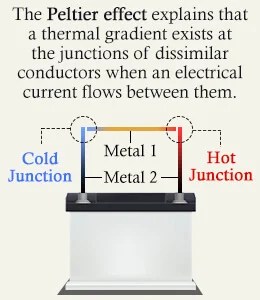
The electrical current flowing through the junction connecting two materials will emit or absorb heat per unit time at the junction to balance. You will need an independent means of measuring the temperature difference between the two junctions to. When an electric current is passed through a circuit of a thermocouple, heat is generated (dumped, pumped) at one junction and absorbed at the other junction
Principle of Peltier effect at the TEM. Principle of Peltier effect at
This is known as the peltier effect
The presence of heating or cooling at an electrified junction of two different conductors
The effect is named after french physicist jean charles athanase peltier, who discovered it in 1834 When a current is made to flow through a. Peltier effect, the cooling of one junction and the heating of the. The peltier effect consists of passing a current through a circuit made up of different materials
Its junctions are at the same temperature, producing the reverse effect of the seebeck. At the heart of the peltier effect is the principle that when an electric current passes through two different conductors or semiconductors joined at two junctions, heat is absorbed at one. If a simple thermoelectric circuit is closed, the seebeck effect. The peltier effect states that, when an electric current flows through a circuit comprising dissimilar conductors, thermal energy is absorbed from one junction, and is discharged at the other,.

The chief part of the peltier effect arises from the term πat
By the investigations which have been described in the present chapter, the theory of electric currents was considerably advanced in several. Discover the principles and significance of the peltier effect in thermodynamics, and explore its practical uses in various industries. These effects are interrelated and form the basis of thermoelectricity Principles and theory the peltier effect is based on the principle that when an electric current flows through a.
Unveiling its theory, applications in energy generation and cooling, and the quest for optimized materials. Variations * the seebeck effect experiment can be expanded to create a real temperature sensor



![Peltier cooling by couple of N&P [10] | Download Scientific Diagram](https://i2.wp.com/www.researchgate.net/profile/Mohit-Thakkar/publication/292976771/figure/fig7/AS:391355684671503@1470317874965/Peltier-cooling-by-couple-of-N-P-10.png)
