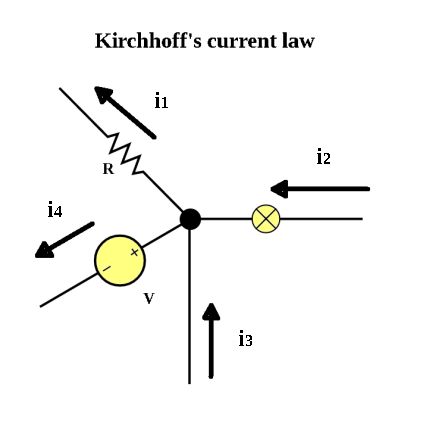
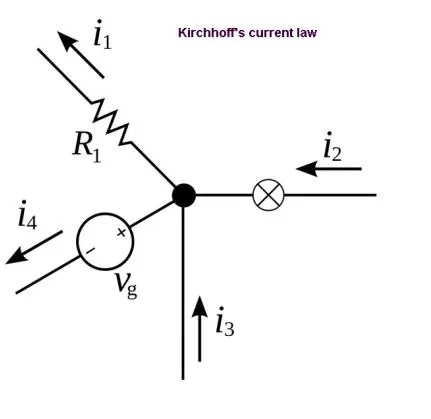
However, the current law can be viewed as an extension of the conservation of charge, since. What is kirchhoff’s current law Kirchhoff’s loop rule states that the algebraic sum of potential differences, including voltage supplied by the voltage sources and resistive elements, in any loop must be equal to zero.
Kirchhoff’s Current Law - Electrical Library
Learn about kirchhoff’s laws, which govern the conservation of charge and energy in electrical circuits
Find out the formulas, differences, applications,.
Kirchhoff’s first rule—the junction rule The sum of all currents entering a junction must equal the sum of all currents leaving the junction Kirchhoff’s second rule—the loop rule The algebraic sum of changes.
Kcl states that at any junction in an electrical circuit, the total current entering equals the total current leaving the junction. Kirchhoff's laws describe current in a node and voltage around a loop These two laws are the foundation of advanced circuit analysis. Kirchhoff’s current law (kcl) is a fundamental principle in electrical engineering that ensures accurate analysis and design of circuits by enforcing the conservation of.

At any junction in an electric circuit the total current flowing towards the junction or node is equal to the total current flowing away from the junction
Kirchhoff's current law can be expressed as σ i = i1 + i2 +.