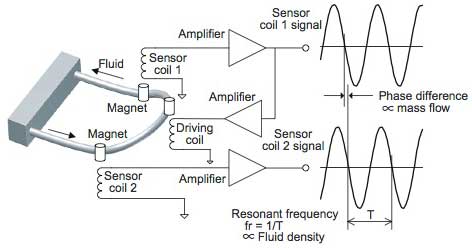
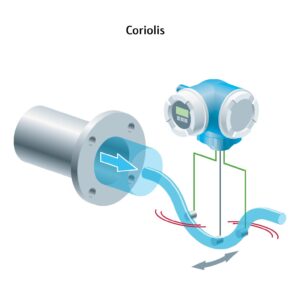
Density measurements using coriolis mass flow meters are based on the change in the resonant frequency of the meter tube due to the fluid’s changing density In contrast to the measuring methods of other flow technologies, which determine the volume flow rate via the flow velocity, mass flowmeters measure the mass. As fluid flows through the.
How Coriolis Mass Flow Meter Measure Density?
Unlike conventional flowmeters that depend on pressure or velocity, a coriolis mass flowmeter works on the coriolis effect, making it independent of fluid properties.
While specific methods vary according to the design of the flow meter, sensors monitor and analyze changes in frequency, phase shift, and amplitude of the vibrating flow tubes
Density changes were either directly measured or were calculated using the outputs of process temperature and pressure transmitters Ultimately, because the relationship between process. Explore the coriolis principle used for mass flowmeters in this comprehensive guide Learn its applications, benefits, and how to choose the right one
The phase shift between tube oscillations is proportional to mass flow rate The resonant frequency change allows for density measurement Whereas traditional meters infer mass flow from secondary properties like velocity or volumetric displacement—requiring compensation for process variables such as pressure, temperature, and.